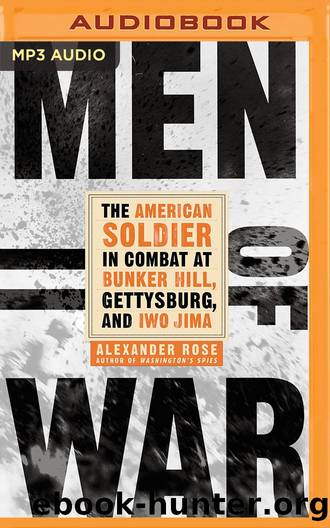
Men of War: The American Soldier in Combat at Bunker Hill, Gettysburg, and Iwo Jima by Alexander Rose
Author:Alexander Rose
Language: eng
Format: azw3, epub, mobi
Tags: United States, Military, History, Veterans, General
ISBN: 9780812996869
Publisher: Random House Publishing Group
Published: 2015-06-09T06:28:24.839000+00:00
7. The Nights
The Marines’ conquest of Iwo Jima was executed strictly by day; the night they yielded to the Japanese. Every dusk, then, the Marines ceased operations and hunkered down along the line in their foxholes.
Of central concern to American units was “tying in” to the ones on either side of them in order to form a straight line across their assigned area. This desire to close gaps in the defensive perimeter and to link up with neighbors began at the division level and continued down successively through the regiment, battalion, company, platoon, squad, and finally, individual foxhole level. There was nothing more dangerous than being left too far forward of the line at nightfall, if, or rather when, the Japanese attacked.
In previous operations, the Japanese had mounted mass banzai charges on the first night of an invasion, and on Iwo Marines accordingly prepared for one—only to be left bewildered when the enemy never appeared, as bewildered, indeed, as when the first wave to hit the beach had encountered paltry counterfire. The actions of the Japanese on Iwo Jima were becoming ever more enigmatic. On other islands, they had emphasized the banzai frontal assault to break through a weak spot on a nascent Marine line. Over the coming weeks on this island, such attacks would be exceptionally rare. Instead, Marines would cope with small-scale “cutting-in attacks,” as the Japanese dubbed them, by infiltrators hoping to create a sense of insecurity behind the lines by sniping opportunistically at random soldiers and sabotaging arms dumps. One remarkably successful effort resulted in a huge explosion at a 4th Division dump as two boatloads of flamethrower fuel, gas, and ammunition went up.
The nocturnal spate of cutting-in attacks wore on Marines to a greater degree than a single, all-out banzai assault at the beginning of an operation. Although banzais were initially terrifying, any satisfactorily tied-in unit could deal with them easily enough: Coordinated machine guns squirting bullets at close range would leave hundreds of Japanese dead and wounded in short order. On Iwo, there were a few attempts to organize banzais, but these were minor piecemeal threats, quickly extinguished. Thus, when Howard Snyder and his squad were facing a trench containing a number of Japanese they could hear were becoming more excited, as if whipping themselves up into a fury before launching a final, diehard bid for glory, he and Harold Keller merely lobbed in grenade after grenade while James Robeson and Louie Adrian used their BARs to cut down anyone who emerged. Eventually, all went silent and that was the end of that.1
This is not to say that infiltration tactics were of much use, however. Kuribayashi was forced to report to Tokyo by the beginning of March that “the look-out American forces became very strict and it is difficult to pass through their guarded line. Don’t overestimate the value of cutting-in attacks,” he advised.2 As Kuribayashi indicated, because Marines actively learned from experience and improved their defensive methods, over the course of the battle these stealth attacks dramatically declined in frequency, skill, and scale.
Download
Men of War: The American Soldier in Combat at Bunker Hill, Gettysburg, and Iwo Jima by Alexander Rose.epub
Men of War: The American Soldier in Combat at Bunker Hill, Gettysburg, and Iwo Jima by Alexander Rose.mobi
This site does not store any files on its server. We only index and link to content provided by other sites. Please contact the content providers to delete copyright contents if any and email us, we'll remove relevant links or contents immediately.
| Africa | Americas |
| Arctic & Antarctica | Asia |
| Australia & Oceania | Europe |
| Middle East | Russia |
| United States | World |
| Ancient Civilizations | Military |
| Historical Study & Educational Resources |
The Battle of Mogadishu by Matt Eversmann;Dan Schilling(683)
Five Four Whiskey by Robert Sweatmon(487)
Level Zero Heroes by Michael Golembesky(467)
Thirteen Soldiers by John McCain(433)
All the Ways We Kill and Die by Brian Castner(414)
A People's History of the U.S. Military by Michael A. Bellesiles(387)
The Bonus Army by Paul Dickson(353)
A More Unbending Battle by Peter Nelson(337)
Bringing Mulligan Home by Dale Maharidge(317)
Sherman Lead by Gaillard R. Peck Jr(314)
Troop Leader by Bill Bellamy(313)
The Little Lead Soldier by Hugh D. Wise(308)
Invisible Heroes of World War II by Jerry Borrowman(291)
Marching Home by Brian Matthew Jordan(290)
It Shouldn't Be This Hard to Serve Your Country by David Shulkin(285)
I Flew for the Fuhrer by Heinz Knocke(252)
Crosshairs on the Kill Zone by Craig Roberts & Charles W. Sasser(248)
What Was Asked of Us by Trish Wood & Bobby Muller(242)
Bulletproofing the Psyche by Kate Hendricks Thomas Ph.D(235)
